Knowledge preparation
Organise the documents and business information that an assistant should use. Define content ownership, update responsibilities and the sources that should remain outside the assistant’s knowledge scope.

DIGITAL SOLUTIONS / XAgent

Indicative product metrics. Targets and scope are confirmed per project.
XAgent connects enterprise knowledge with an assistant designed around a specific business use case. It brings retrieval, access rules and agreed business actions into one implementation scope. The aim is useful assistance with traceable context, clear operating boundaries and a practical route to human review.
CORE CAPABILITIES
Shape the product around your business process, information and responsibilities.
Organise the documents and business information that an assistant should use. Define content ownership, update responsibilities and the sources that should remain outside the assistant’s knowledge scope.
Design answers around relevant material from the connected knowledge sources. Source references help users understand the context of an answer and check the underlying information when a decision needs closer review.
Shape the assistant’s role, instructions and boundaries around a defined task. A focused configuration gives the implementation team a clearer basis for evaluating useful answers and unsuitable responses.
Plan knowledge access around the organisation’s existing responsibilities. Review identity, permissions and sensitive information before deciding what different user groups can ask the assistant to retrieve.
Connect the assistant with agreed business tools or workflow steps. Define which actions need approval, how errors are surfaced and when a person should take over the process.
Build a review set from representative business questions and difficult edge cases. Use that evidence to improve the knowledge structure and assistant configuration before extending the scope.
BUSINESS WORKFLOW
An internal knowledge assistant connects a question with approved sources, access boundaries and a practical route to human review.
A colleague submits a question within the assistant’s agreed business scope.
The implementation limits retrieval to the knowledge available to that user.
Relevant material is selected from the connected, maintained knowledge sources.
The assistant drafts a response with references to the supporting material.
The user checks the answer and routes any consequential action for human approval.
Ask for clarification or hand the question to a responsible specialist rather than treating an unsupported answer as a decision.
The response keeps its source references available and leaves business commitments with the responsible team.
TYPICAL APPLICATIONS
Start with a practical use case and extend the scope as your team develops its working approach.
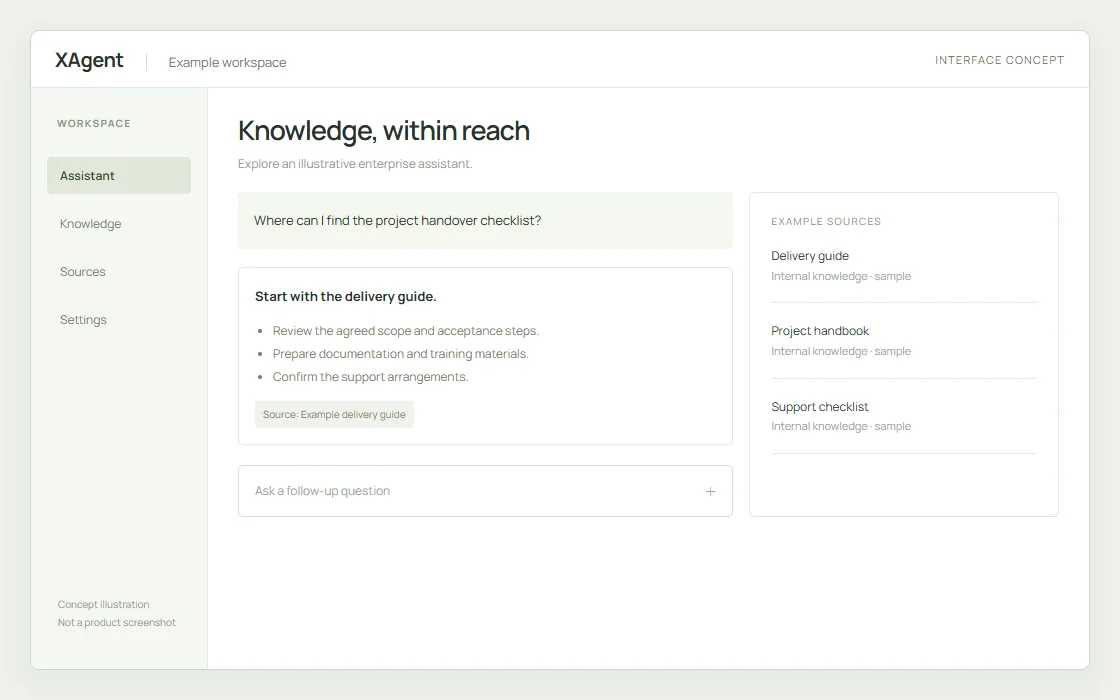
Explore how a question, a draft answer and supporting source material could sit together. Define the review route and knowledge access around the intended use case.
Interface concept with sample data, not an actual product screenshot.
Help colleagues find policy, product and operating information. Keep source material available for review when a question affects a business decision.
Support preparation for product and customer conversations using approved business knowledge. Keep pricing commitments and commercial decisions with the responsible team.
Organise an initial question, retrieve relevant guidance and prepare a clearer handover. Define the cases that should move directly to a human service specialist.
Make operating instructions easier to consult during a task. Keep engineering, safety and other consequential decisions within the agreed human review process.
DELIVERY & INTEGRATION
Language, hosting, access, interfaces and acceptance criteria are part of implementation planning.
Choose a focused use case and prepare representative questions, approved knowledge and evaluation criteria. Agree the assistant’s boundaries and human review route before rollout.
Define knowledge connectors, identity, hosting location and any tool actions in the project design. Review permissions, data handling and approval requirements for each connection.
Provide administrator guidance for knowledge updates, response review and issue handling. Revisit the evaluation set as business knowledge and assistant responsibilities change.
YOUR NEXT STEP
Share your project location, operating requirements and timeline. We will work with you on a clear scope and next steps.
Discuss your requirements